- Sep 1, 2025
Make Wisdom Sexy Again
- Rachel Bulkley

There’s a phenomenon I’ve witnessed for years and just cannot get over: the way we collectively confuse intelligence with wisdom. I’m convinced that understanding this difference could revolutionize our lives and society without the need for marches, protests, or soul-destroying debates that result in a social hellscape.
Wisdom isn’t a sexy word. It conjures images of prune-faced elderly individuals speaking in a low tone and slow cadence, forcing listeners to strain forward. But that’s just because wisdom has never seen the benefit of a good public relations campaign. Allow me to advocate for wisdom and its egoless disposition. We should consider inviting Wisdom to the podium.
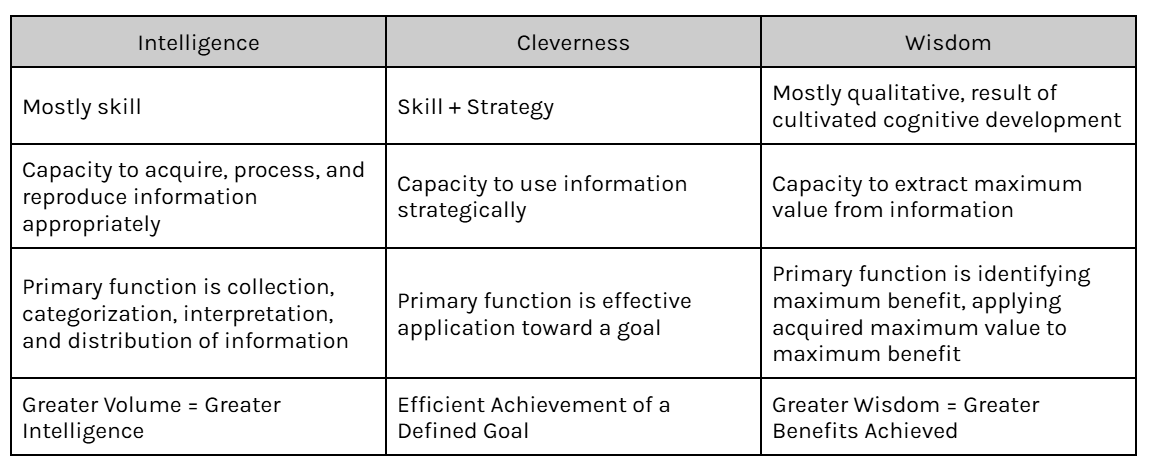
We're often impressed by uncommon intelligence, or its half-breed sibling, cleverness. When it comes time to select our leaders—whether democratically or by hitting “Follow” on our phones—we choose those who dazzle, not necessarily those who deserve our attention. The table below gives you an idea of where I'm headed.
Stay with me, I promise to make it make sense.
Defining Intelligence
My personal definition of intelligence is simple: the capacity to absorb, process, and produce or reproduce information. Memorization alone doesn’t qualify—you have to comprehend and communicate effectively, not just repeat things back.
Intelligence is a skill, and it’s valuable. We rely on the knowledge others have collected and made available to us. The more capacity to provide us with knowledge, the more valuable we find them.
If you spend any length of time around me, you’re bound to hear the phrase, “Information is not transformation.” Often. In this case, information isn’t application.
Intelligence is valuable for gathering the raw materials needed in constructing life. The problem comes when we forget its nature and its limits. Intelligence has no correlation to character. I don’t just mean moral fiber. I mean the developmental substance—the heft and reliability—needed from the people and things we entrust our safety to.
The Limits of Intelligence
The tragic failure of the Oceangate submersible is a stark reminder of the limits of intelligence. Stockton Rush, an intelligent and ambitious individual, had studied engineering at Princeton. Yet, the details of the tragedy—the unheeded warnings and avoided regulations—offer a clear example of how intelligence can fall short.
We can't assume what drove Rush's specific decisions, but we can observe that his leadership and his vessel were not sufficient for the weight of the mission. Intelligence can only take you so far; it requires additional qualities to withstand intense pressure. The materials of the submersible itself were sufficient for construction but failed when put into service under extreme pressure. They were simply not fitted to withstand the forces of the deep.
For that voyage to have succeeded, it would have required wisdom. This wisdom would have prioritized safety over ego, ambition, or carelessness. It would have insisted on building with materials that were tested, tempered, and proven. The vessel was impressive on the surface, but like intelligence, it was unfit for the depths. Intelligence can design, but without wisdom, it will collapse under the pressure of competing drives.
Defining Wisdom
Wisdom is the ability to extract maximum value from information. It doesn’t need volumes of information. It can take something simple and draw infinite value from it. One sentence—“Do unto others as you would have them do unto you”—is enough to build an entire life on.
Humanity’s greatest teachers always taught simple, practical lessons. Wisdom doesn’t require advanced degrees. It extracts enormously from the simplest truths. And, in time, our most sophisticated research only ends up proving what wisdom traditions have been saying all along.
It’s not a skill—it’s a quality. It’s a perspective that comes from maturity. Maturity isn’t automatic. It comes from time, trial, failure, reflection, and improvement.
Wisdom isn’t moral superiority. It’s the natural outcome of robust human development.
Human Development and the Path to Wisdom
Humans begin egocentric. We have no choice but to start inside the body and being of one individual with all-encompassing needs. As those needs are met sufficiently, they give way to more sophisticated ones.
Maslow gave us a handy visual of this with his hierarchy.
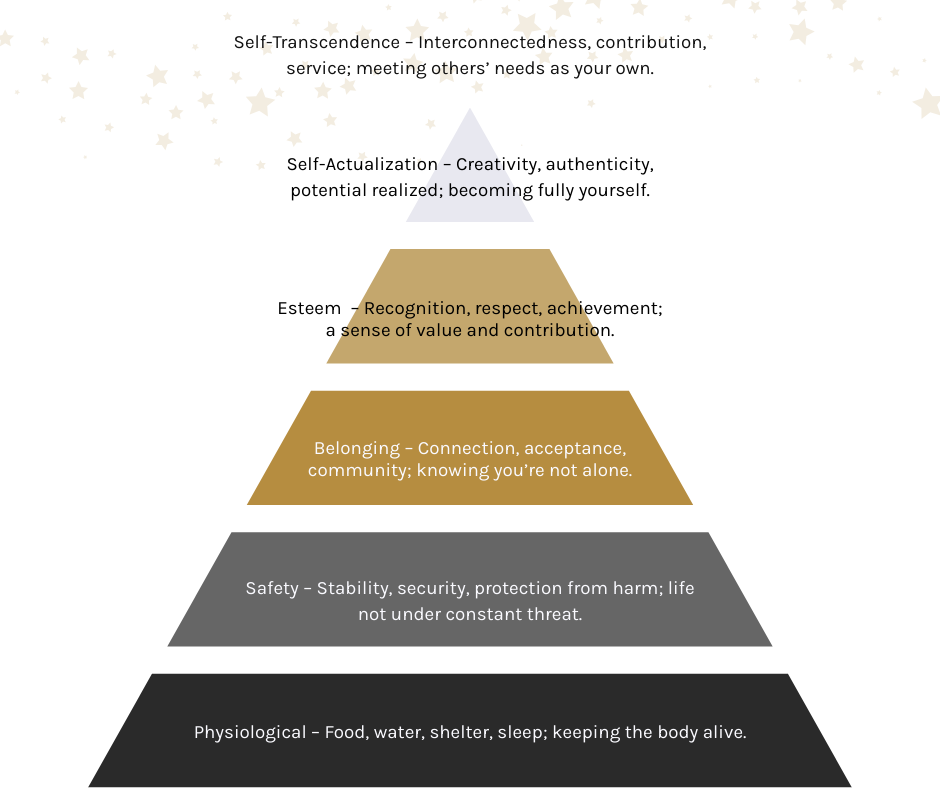
We often treat self-actualization as the pinnacle of development. It isn’t. Once you’ve experienced it—understood your uniqueness, exercised your creativity, earned recognition—growth does not end. Humans are nature, and in nature, if you aren’t growing, you’re dying.
Beyond actualization comes transcendence. When your needs are satisfied, you awaken to your interdependence with others. It becomes your need to meet theirs. Not because you’ve turned saintly, but because that’s the reality of human existence: we are connected.
Transcendence is limitless. There are always more neighbors, always more growth. That isn’t bad news—it’s good news. Development doesn’t retire. It expands outward, endlessly.
Wisdom as Maximum Value
This is why wisdom, at its core, is about extracting maximum value. Healthy development always moves toward collective benefit. So maximum value is always aimed at maximum benefit to all.
Selfish ambition is just a sign of underdevelopment. It’s proof of stunted growth—unmet needs—malnourished humanity. No one would consciously choose to remain underdeveloped, but selfish aims reveal exactly that.
Wisdom, by contrast, is the path to both personal fulfillment and collective flourishing.
Implications for Leadership
So what does this mean for leadership?
Intelligence can be measured in volume—how much knowledge a person can absorb and process. Wisdom is measured by value—how much can be drawn from what’s at hand.
The ideal leader is both intelligent and wise. But if forced to choose, wisdom always wins. A wise leader surrounds themselves with intelligent advisors. They aren’t threatened by brilliance. They elevate others who bring good to the collective.
An intelligent or clever leader without wisdom is a gamble. Intelligence alone cannot be trusted to discern its own best interest—let alone in the interest of the collective.
Conclusion
Intelligence is valuable, but insufficient. Wisdom is the truest measure of development. It is the path to transcendence, the path to flourishing, and the foundation of trustworthy leadership.
We all know what humans find sexy—vitality, virality, youthful stamina—all the signs of a flourishing individual.
If we want flourishing societies, we must stop confusing intelligence with wisdom—and start choosing leaders with the stamina for the depths.